
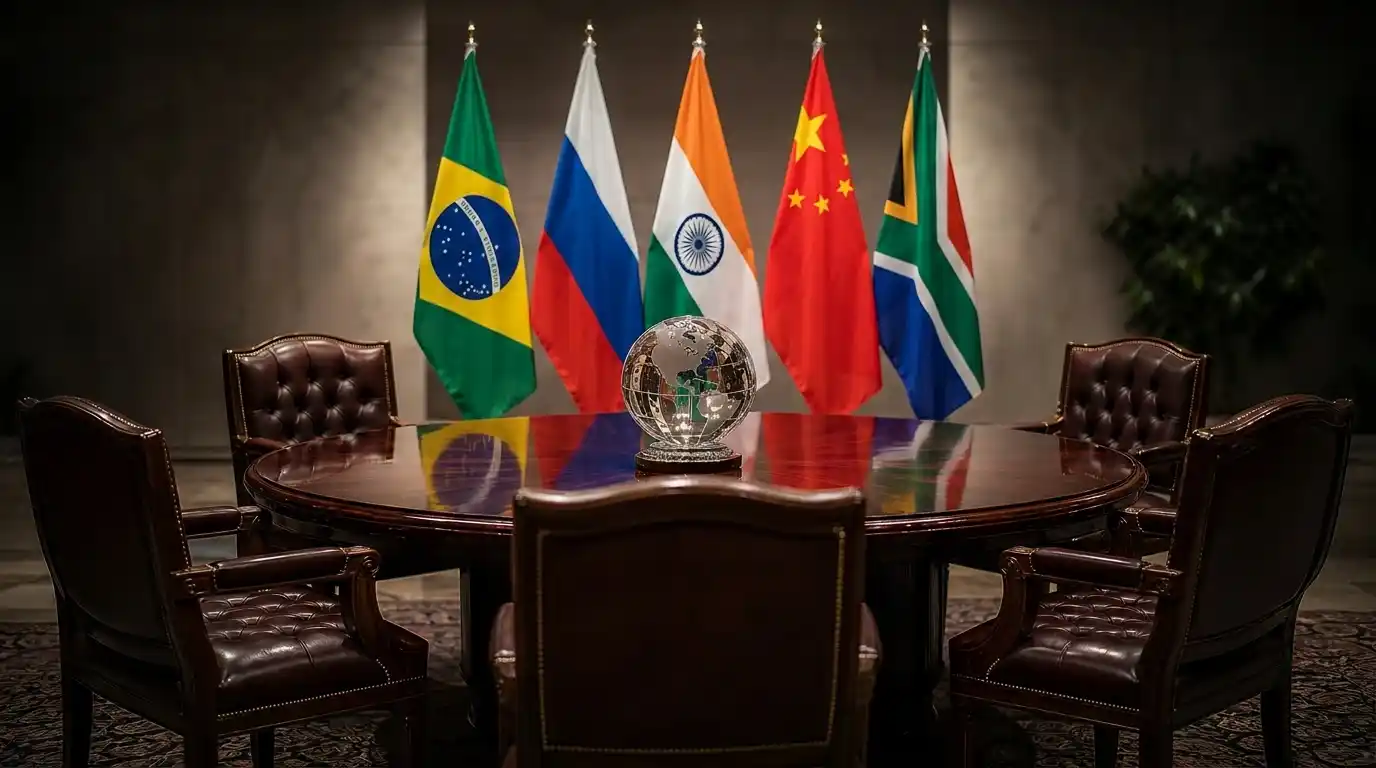
BRICS Foreign Ministers convened in New Delhi under India's chairmanship, with External Affairs Minister S. Jaishankar presiding over discussions on the West Asia crisis, advocacy for a two-state solution, and firm opposition to unilateral sanctions.
One Liners
| Fact / Entity | Detail |
|---|---|
| What | BRICS Foreign Ministers Meeting |
| When | May 2026 |
| Where | New Delhi, India |
| Who chaired | External Affairs Minister S. Jaishankar |
| Organisation | BRICS (Brazil, Russia, India, China, South Africa + new members) |
| Agenda Focus | West Asia crisis; two-state solution; opposition to unilateral sanctions |
| Significance | India's push for a multipolar world order and Global South representation |
Why in News?
The BRICS Foreign Ministers Meeting in New Delhi, chaired by EAM S. Jaishankar, signals India's diplomatic pivot toward institutionalising BRICS as a counterweight to Western-centric global governance. The focus on West Asia and opposition to unilateral sanctions aligns with India's "Vishwa Bandhu" positioning amid the ongoing West Asia war and rising energy price volatility.
Keyword/Terminology Hub
- BRICS: Intergovernmental organisation comprising Brazil, Russia, India, China, South Africa, and new member states (2024 expansion), representing emerging economies and the Global South.
- Multipolar World Order: Geopolitical framework where power is distributed among multiple sovereign states and blocs rather than dominated by a single superpower or Western alliance.
- Unilateral Sanctions: Economic or political penalties imposed by one state or a small group without United Nations Security Council authorisation, increasingly contested by Global South nations.
- Two-State Solution: Internationally endorsed framework for resolving the Israel-Palestine conflict through the establishment of two sovereign states living side by side in peace and security.
Background & Static Concept Link
- Definition: BRICS is an intergovernmental organisation of emerging economies founded to promote cooperation, reform global governance institutions, and advance the interests of the Global South in multilateral forums.
- Historical Origin: The acronym "BRIC" was coined by Goldman Sachs economist Jim O'Neill in 2001 to describe the four rapidly growing economies of Brazil, Russia, India, and China. South Africa joined in 2010, transforming it into BRICS. The first formal summit was held in Yekaterinburg, Russia, in 2009.
- Constitutional/Legal Framework: BRICS is not a treaty-based organisation like NATO or the UN; it operates through summit declarations, ministerial meetings, and consensus-based communiqués without a formal charter or binding legal obligations.
- Institutional Framework:
- New Development Bank (NDB): BRICS' multilateral development bank headquartered in Shanghai, providing infrastructure and sustainable development financing.
- Contingent Reserve Arrangement (CRA): A financial safety net for BRICS members facing balance-of-payments pressures.
- BRICS Pay: Proposed cross-border payment mechanism to reduce dependence on dollar-dominated financial systems.
- Various Working Groups: Covering counter-terrorism, energy, health, education, and trade.
- Chronology/Timeline:
| Year | Event |
|---|---|
| 2001 | Jim O'Neill coins the term "BRIC" in Goldman Sachs report |
| 2006 | First BRIC Foreign Ministers meeting on the sidelines of UNGA |
| 2009 | First BRIC Summit held in Yekaterinburg, Russia |
| 2010 | South Africa invited to join; BRICS formally constituted |
| 2014 | Fortaleza Summit establishes NDB and CRA |
| 2015 | NDB begins operations; K.V. Kamath becomes first President |
| 2023 | 15th BRICS Summit in Johannesburg discusses expansion criteria |
| 2024 | BRICS expansion with Egypt, Ethiopia, Iran, UAE, and Saudi Arabia |
| 2025–2026 | India assumes BRICS chairmanship; 16th Summit scheduled in 2026 |
| May 2026 | BRICS Foreign Ministers Meeting convened in New Delhi |
- Related Static Topics / Cross References:
- Similar concepts: G7, G20, SCO, Quad, IBSA
- Linked schemes: India's SAGAR doctrine, Act East Policy, Development Partnership Administration
- Associated reports: BRICS Summit Declarations (annual), NDB Annual Reports
- Comparative examples: G7 Foreign Ministers meetings; ASEAN Regional Forum
Key Provisions / Main Developments
| Development | Strategic Detail |
|---|---|
| West Asia Crisis | Ministers discussed the ongoing conflict; advocated for an immediate ceasefire and de-escalation |
| Two-State Solution | Collective reaffirmation of support for Palestinian statehood alongside Israel as the viable path to peace |
| Unilateral Sanctions | Firm opposition expressed to sanctions imposed outside the UN framework, framing them as tools of economic coercion |
| Multipolarity Push | Call for reform of global financial and security architecture to reflect contemporary power realities |
| Global South Bridge | India's "Vishwa Bandhu" positioning — acting as intermediary between emerging economies and traditional powers |
Mains Perspective (SPECTEL Analysis)
- Political/Legal impact: BRICS is transitioning from an investment acronym to a geopolitical coalition challenging Western institutional hegemony. India's chairmanship allows it to shape the agenda toward Global South priorities — debt sustainability, climate justice, and equitable vaccine access — while avoiding overt anti-Western posturing that could strain its Quad and G7 engagements.
- Economic impact: Opposition to unilateral sanctions protects BRICS members' trade relationships and challenges the weaponisation of the dollar-dominated SWIFT system. This aligns with India's interest in de-risking its energy and defence imports from payment disruptions.
- Constitutional/Cultural impact: Reinforces India's civilisational self-image as "Vishwa Bandhu" (Global Friend) — a bridge-builder rather than a bloc-member. It demonstrates India's ability to simultaneously engage with competing geopolitical architectures without binary alignment.
- Logical/Ethical conclusion: The Delhi meeting demonstrates that BRICS has acquired diplomatic gravity, but internal contradictions — India-China border tensions, divergent interests on Russia-Ukraine, and the inclusion of West Asian rivals (Iran, Saudi Arabia, UAE) — fundamentally limit its coherence as a unified geopolitical force.
Fact-Check & Committees
- Relevant Data/Stats: As per recent BRICS declarations, the grouping represents approximately 45% of the world's population and around 35% of global GDP in purchasing power parity (PPP) terms. The New Development Bank has approved cumulative financing of over $30 billion across more than 100 projects since its inception in 2015. India is the current BRICS chair for 2025–2026, a rotational position held annually.
- Committee/Judgment: Fortaleza Declaration (2014): Established the NDB and CRA, marking BRICS' institutional maturation. Johannesburg II Declaration (2023): Framed the criteria and process for BRICS expansion. BRICS operates without a formal secretariat or treaty; decisions are consensus-based and embodied in summit communiqués rather than legally binding instruments.
- Quote: "BRICS is not an alliance against anyone. It is an arrangement for the betterment of the world and for giving voice to the Global South." — External Affairs Minister S. Jaishankar.
Exam Lens
- UPSC/State PCS Mains angle: "BRICS has evolved from an economic concept to a geopolitical platform. Examine India's strategic interests in strengthening BRICS amid its simultaneous deep engagement with Western-led multilateral institutions like the Quad and G7."
- Essay angle: "In a fragmenting world order, can BRICS offer a credible alternative to Western hegemony without becoming an anti-Western bloc?"