
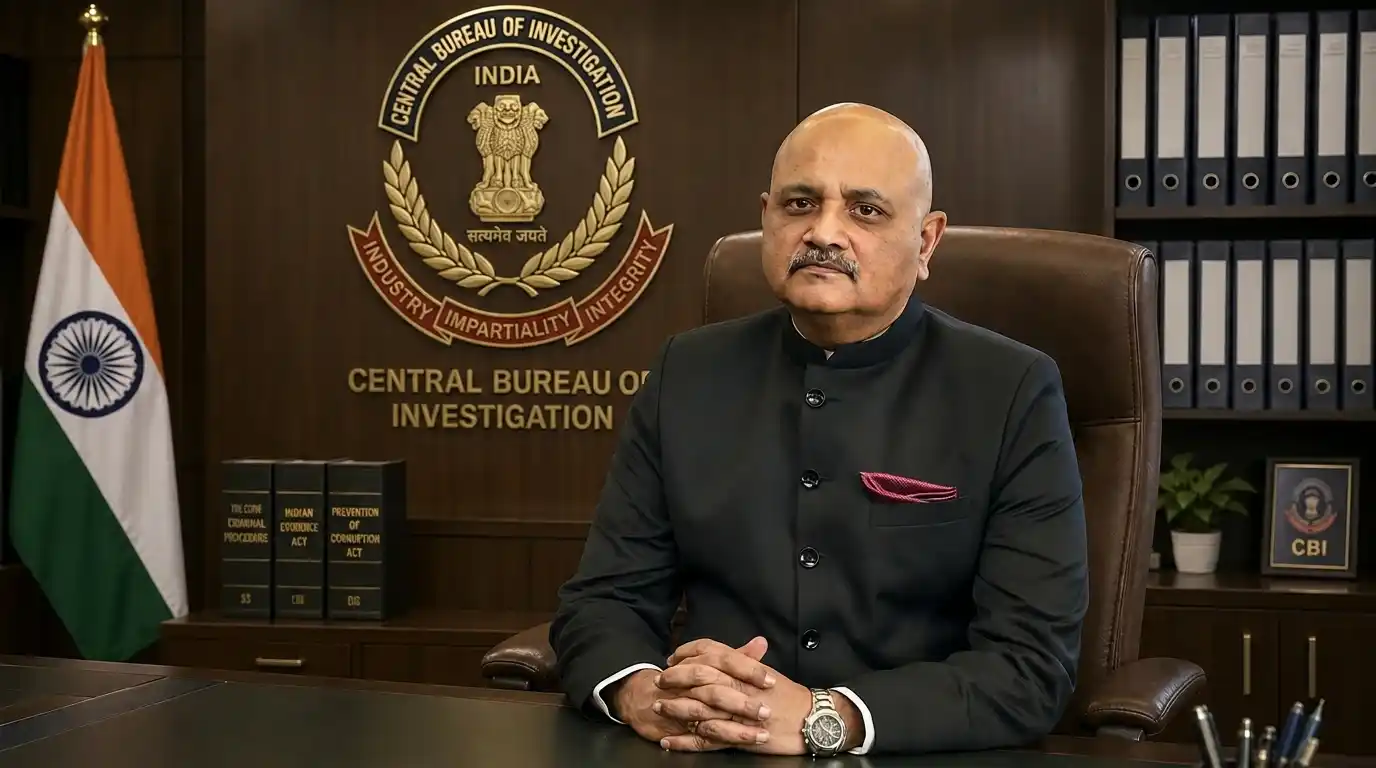
The Appointments Committee of the Cabinet granted a one-year extension to CBI Director Praveen Sood, reigniting debates on the agency's operational independence and the adequacy of judicial safeguards against executive interference.
One Liners
| Fact / Entity | Detail |
|---|---|
| What | ACC granted one-year extension to CBI Director Praveen Sood |
| When | May 2026 |
| Who | Appointments Committee of the Cabinet (ACC); Praveen Sood |
| Ministry | Ministry of Personnel, Public Grievances and Pensions |
| Legal Origin | Delhi Special Police Establishment (DSPE) Act, 1946 |
| Key Outcome | One-year extension to CBI Director's tenure |
| Landmark Context | Supreme Court's Vineet Narain judgment (1997) on CBI autonomy |
| Headquarters | New Delhi |
Why in News?
The ACC's decision to extend CBI Director Praveen Sood's tenure by one year in May 2026 preserves institutional continuity but simultaneously revives concerns about executive leverage over India's premier investigating agency. The extension tests the durability of the Supreme Court's Vineet Narain safeguards, which were designed to insulate the CBI from arbitrary administrative interference and ensure fixed-tenure security.
Keyword/Terminology Hub
- DSPE Act, 1946: Founding legislation establishing the Delhi Special Police Establishment, the statutory predecessor to the CBI, empowering investigation of corruption in central government transactions.
- Vineet Narain Judgment (1997): Landmark Supreme Court verdict mandating fixed tenure, CVC supervision, and high-powered selection for the CBI Director to insulate the agency from political interference.
- Appointments Committee of the Cabinet (ACC): High-level executive body chaired by the Prime Minister that approves senior bureaucratic and investigative appointments, including CBI Director extensions.
- CBI Autonomy: The principle of operational and administrative independence from the executive, essential for credible investigation of high-profile corruption and criminal cases.
- Fixed Tenure: A predetermined, non-extendable tenure period designed to prevent premature removal or transfer of institutional heads under political pressure.
Background & Static Concept Link
- Definition: The Central Bureau of Investigation (CBI) is India's premier investigating agency, functioning under the administrative control of the Ministry of Personnel, Public Grievances and Pensions, and deriving its investigative powers from the Delhi Special Police Establishment Act, 1946.
- Historical Origin: Established in 1946 as the DSPE to probe corruption in war supply contracts, it was renamed CBI in 1963 and expanded into a multi-disciplinary agency handling anti-corruption, economic offences, and special crimes.
- Constitutional/Legal Framework:
- DSPE Act, 1946: Provides the statutory charter for CBI's constitution, powers, and jurisdiction.
- Lokpal and Lokayuktas Act, 2013: Brings CBI under Lokpal jurisdiction and mandates a selection committee (PM, LoP, CJI) for Director appointment.
- CVC Act, 2003: Codifies Central Vigilance Commission's supervisory role over CBI's anti-corruption functions.
- Article 21: Right to life and personal liberty, judicially interpreted to include the right to fair and impartial investigation.
- Institutional Framework:
- CBI Director: Head of the agency, traditionally a senior Indian Police Service officer.
- Central Vigilance Commission (CVC): Statutory supervisory authority over CBI's anti-corruption investigations.
- Ministry of Personnel: Administrative ministry providing budgetary and logistical support.
- Lokpal: Ombudsman with jurisdiction to direct CBI investigations in corruption cases involving public servants.
- Chronology/Timeline:
| Year | Event |
|---|---|
| 1946 | DSPE established under the DSPE Act to investigate procurement fraud |
| 1963 | CBI formally constituted as a national investigating agency |
| 1987 | Vineet Narain v. Union of India filed following Bofors scandal exposure |
| 1997 | Supreme Court delivers Vineet Narain judgment mandating CBI autonomy, fixed tenure, and CVC supervision |
| 2003 | CVC Act enacted, partially codifying Vineet Narain directives |
| 2013 | Lokpal Act provides selection committee mechanism for CBI Director appointment |
| 2013 | Supreme Court describes CBI as a "caged parrot" during Coalgate hearings |
| 2021 | DSPE Act amended to provide minimum 2-year tenure for CBI Director |
| May 2026 | ACC grants one-year extension to CBI Director Praveen Sood |
- Related Static Topics / Cross References:
- Similar concepts: Enforcement Directorate autonomy, NIA independence, Lokpal institutional framework
- Linked schemes: Central Government's anti-corruption initiatives, Whistleblower protection mechanisms
- Associated reports: Law Commission reports on criminal procedure reforms; PAC recommendations on CBI autonomy
- Comparative examples: FBI Director tenure (10-year fixed term in the United States); UK's National Crime Agency independence model
Key Provisions / Main Developments
| Development | Operational Detail |
|---|---|
| ACC Extension Order | One-year extension granted to CBI Director Praveen Sood beyond existing tenure |
| Administrative Basis | DSPE Act provisions governing Director appointment and tenure |
| Institutional Continuity | Ensures leadership stability during ongoing high-profile investigations |
| Autonomy Concern | Executive discretion over extensions potentially undermines fixed-tenure safeguards |
| Vineet Narain Context | Extension revives debate on whether judicially-mandated insulation is structurally adequate |
Mains Perspective (SPECTEL Analysis)
- Benefits: Leadership continuity prevents disruption in complex, multi-year investigations involving economic offences and corruption. Institutional memory is preserved at the highest level.
- Challenges: The power to grant extensions creates a structural dependency of the Director on the executive, potentially influencing investigative trajectories in politically sensitive cases.
- Criticism: Critics argue that any extension mechanism contradicts the spirit of Vineet Narain, which envisioned a fixed, non-extendable tenure as the bulwark against "caged parrot" dynamics.
- Governance issues: Lack of transparency in ACC deliberations and absence of statutory criteria for extensions raise accountability deficits. The selection committee under the Lokpal Act governs initial appointment but not post-tenure extensions.
- Constitutional concerns: Article 21's guarantee of fair investigation requires not merely procedural fairness but institutional insulation from partisan pressure. Extensions that keep the Director in office at executive pleasure risk constitutional infirmity.
- Political/Legal impact: The extension tests the outer limits of executive administrative power over constitutional-function agencies. It signals whether the post-Vineet Narain framework has genuinely depoliticised the CBI or merely relocated political leverage from appointment to extension decisions.
- Constitutional/Cultural impact: Reinforces the persistent challenge of creating "independent" institutions within a parliamentary system where the executive dominates appointments. The "caged parrot" metaphor continues to haunt India's institutional imagination.
- Logical/Ethical conclusion: A fixed tenure without extension possibilities is the only structural guarantee of independence. The ACC's discretionary power to extend, however well-intentioned, reintroduces the very executive leverage that the Supreme Court sought to eliminate. Genuine autonomy requires statutory bars on extension, not merely judicial exhortations.
Fact-Check & Committees
- Relevant Data/Stats: The CBI operates through over 7,000 personnel across multiple divisions including Anti-Corruption, Economic Offences, and Special Crimes. The 2021 amendment to the DSPE Act statutorily provided a minimum tenure of not less than two years for the CBI Director. The agency investigated over 1,000 cases annually in recent years, with conviction rates varying by offence category.
- Committee/Judgment: Vineet Narain v. Union of India (1997): The Supreme Court laid down specific safeguards — fixed tenure, CVC supervision, and selection through a high-powered committee — to insulate the CBI and Enforcement Directorate from political interference. The Court held that the "integrity of the institution must be preserved." Supreme Court observations (2013): During the Coalgate hearings, the Court famously described the CBI as a "caged parrot speaking in its master's voice," underscoring the gap between legal safeguards and operational reality.
- Quote: "The CBI has become a caged parrot speaking in its master's voice." — Supreme Court of India, Coalgate proceedings, 2013.
Exam Lens
- UPSC/State PCS Mains angle: "The CBI's effectiveness as an investigating agency is undermined not by a lack of legal powers but by structural dependence on the executive. Critically examine the adequacy of the Vineet Narain safeguards in ensuring CBI autonomy, with reference to the implications of tenure extensions."
- Essay angle: "Institutional independence in a democracy: The case of India's investigating agencies and the challenge of executive oversight without executive capture."