
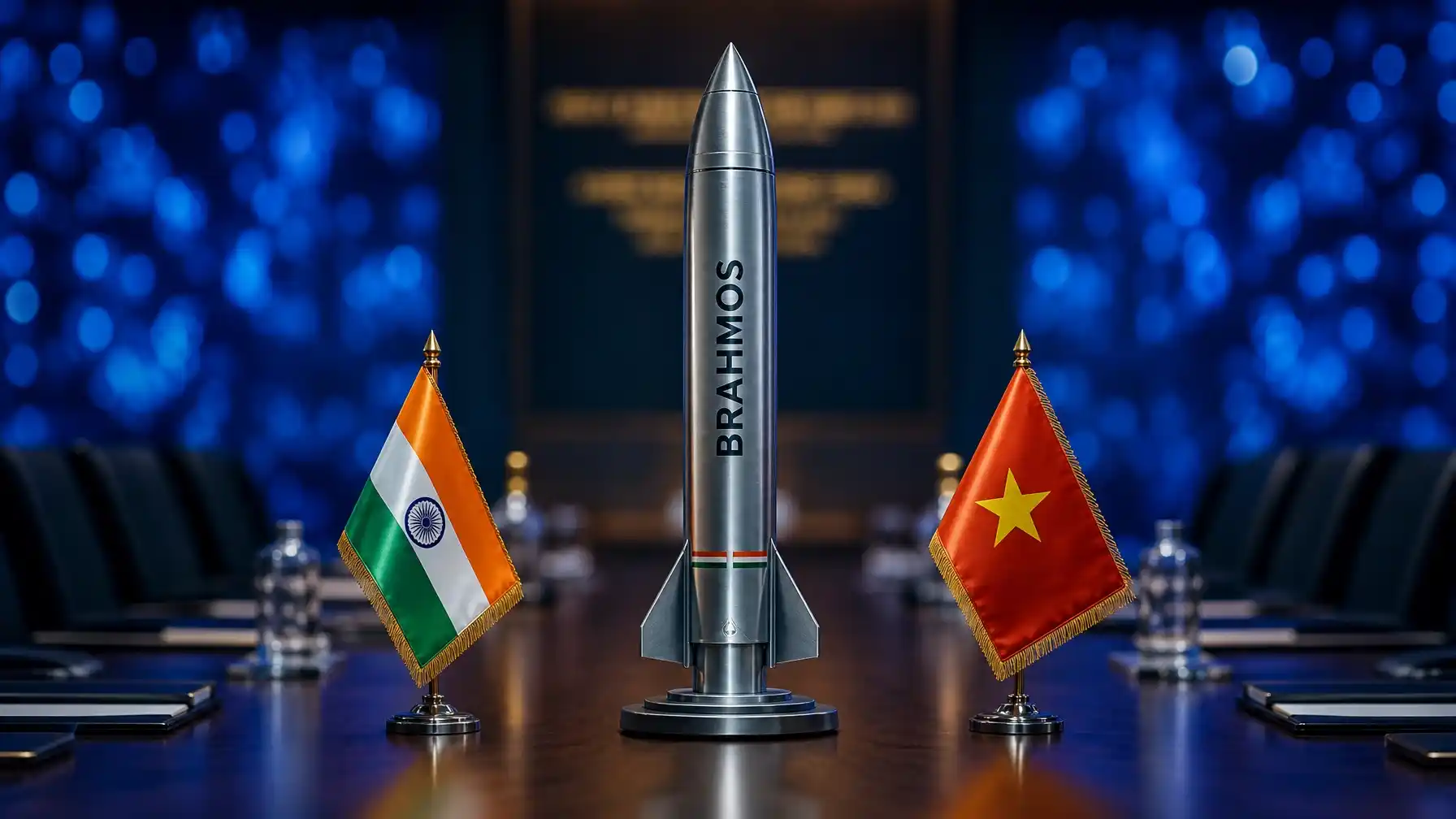
India elevated bilateral relations with Vietnam to an Enhanced Comprehensive Strategic Partnership (ECSP) in May 2026, focusing on maritime security cooperation and potential BrahMos missile exports as a core component of the Act East Policy.
---
One Liners
| Fact / Entity | Detail |
|---|---|
| What | India-Vietnam ties elevated to Enhanced Comprehensive Strategic Partnership (ECSP) |
| When | May 2026 |
| Who | India and Socialist Republic of Vietnam |
| Ministry/Organization | Ministry of External Affairs; Ministry of Defence |
| Key Focus | Maritime security; defence transfers; potential BrahMos missile exports |
| Policy Anchor | Act East Policy |
| Strategic Context | Heightened South China Sea tensions; India's Indo-Pacific push |
| Previous Tier | Comprehensive Strategic Partnership (2016) |
Why in News?
India elevated bilateral ties with Vietnam to an Enhanced Comprehensive Strategic Partnership (ECSP) in May 2026, focusing on maritime security and potential BrahMos missile exports. The upgrade comes amid heightened South China Sea tensions and aligns with India's Indo-Pacific push, reinforcing Vietnam as a key Act East policy anchor in Southeast Asia.
Keyword/Terminology Hub
- Enhanced Comprehensive Strategic Partnership (ECSP): Highest tier of Vietnam's diplomatic classification, denoting multi-domain strategic cooperation across defence, economic, and technological domains.
- BrahMos Missile: Indo-Russian joint venture supersonic cruise missile with export potential to friendly nations, representing India's entry into offensive defence exports.
- Act East Policy: India's strategic pivot toward deeper economic, diplomatic, and defence engagement with Southeast and East Asia, upgraded from the Look East Policy in 2014.
- South China Sea: Disputed maritime region where Vietnam faces Chinese assertiveness, creating strategic convergence with India's freedom of navigation and rules-based order interests.
Background & Static Concept Link
- Definition: India-Vietnam relations encompass diplomatic, defence, economic, and cultural cooperation rooted in anti-colonial solidarity, consolidated through successive partnership upgrades from Strategic Partnership (2007) to Comprehensive Strategic Partnership (2016) and now ECSP (2026).
- Historical Origin: Diplomatic relations established in 1972. India provided development assistance during Vietnam's post-war reconstruction and supported its international integration. Vietnam consistently backs India's UN Security Council membership aspirations and ASEAN engagement.
- Constitutional/Legal Framework: Bilateral cooperation operates through Joint Statements, Memoranda of Understanding, and Lines of Credit rather than formal treaty obligations. Defence exports are governed by India's Foreign Trade (Development and Regulation) Act and the Special Chemicals, Organisms, Materials, Equipment and Technologies (SCOMET) export control framework.
- Institutional Framework:
- Ministry of External Affairs (East Asia Division): Coordinates bilateral diplomatic and strategic dialogue.
- Ministry of Defence: Facilitates defence cooperation, training, and technology transfer.
- Indian Navy: Conducts bilateral exercises, port calls, and capacity-building in the South China Sea.
- BrahMos Aerospace: Joint venture between DRDO and Russia's NPO Mashinostroyeniya handling missile production and export.
- Vietnam's Ministry of National Defence: Counterpart for military-to-military engagement.
- Chronology/Timeline:
| Year | Event |
|---|---|
| 1972 | Diplomatic relations established between India and Vietnam |
| 2000 | Defence cooperation agreement signed |
| 2007 | Strategic Partnership established during PM Manmohan Singh's visit to Hanoi |
| 2014 | India's Look East Policy upgraded to Act East Policy under PM Modi |
| 2016 | Comprehensive Strategic Partnership signed during PM Modi's visit |
| 2020 | India-Vietnam Joint Vision for Peace, Prosperity and People adopted |
| 2022–24 | India supplies 12 high-speed patrol boats to Vietnam under $100 million LOC |
| May 2026 | Ties elevated to Enhanced Comprehensive Strategic Partnership (ECSP); BrahMos export discussions advance |
- Related Static Topics / Cross References:
- Similar concepts: India-Philippines defence cooperation; India-Indonesia strategic partnership; Quad maritime security cooperation
- Linked schemes: Indo-Pacific Oceans Initiative (IPOI); SAGAR Doctrine; Development Partnership Administration projects in Vietnam
- Associated reports: ASEAN-India Joint Statement on Cooperation in the ASEAN Outlook on the Indo-Pacific; India's Indo-Pacific strategy documents
- Comparative examples: US-Vietnam Comprehensive Strategic Partnership (2023); Japan-Vietnam Extensive Strategic Partnership
Key Provisions / Main Developments
| Development | Strategic Detail |
|---|---|
| ECSP Upgrade | Highest tier of Vietnam's diplomatic partnership framework, placing India alongside Russia, China, and the United States |
| Maritime Security | Enhanced naval cooperation, joint patrols, and maritime domain awareness in the South China Sea and Indian Ocean |
| Defence Transfers | Potential export of BrahMos supersonic cruise missiles; ongoing delivery of patrol boats under LOC |
| Act East Anchor | Vietnam positioned as the central politico-military node for India's Southeast Asia and Indo-Pacific strategy |
Mains Perspective (SPECTEL Analysis)
- Political/Legal impact: The ECSP upgrade institutionalises Vietnam as India's highest-tier partner in Southeast Asia, creating a durable framework for defence technology transfer and joint maritime operations. Potential BrahMos export would mark India's first major offensive weapon system sale to a Southeast Asian nation, signalling a shift from development partner to credible security provider in the Indo-Pacific.
- Economic impact: Maritime security cooperation protects sea lines of communication critical for India's trade with East Asia. Vietnam's strategic location at the eastern edge of the Indian Ocean creates a logistics and surveillance node that supports India's economic connectivity initiatives, including the India-Myanmar-Thailand Trilateral Highway and Mekong-Ganga Cooperation.
- Constitutional/Cultural impact: Reinforces India's civilisational and historical ties with Vietnam — Buddhist linkages, anti-colonial solidarity, and shared resistance to external domination — as soft power assets that complement and legitimise hard security cooperation.
- Logical/Ethical conclusion: The ECSP with Vietnam is not merely bilateral diplomacy but a geopolitical investment in a multipolar Indo-Pacific. It demonstrates India's capacity to provide security alternatives to smaller nations facing great-power coercion without demanding formal alliance, military bases, or political alignment, thereby advancing a rules-based regional order.
Fact-Check & Committees
- Relevant Data/Stats: As per the Ministry of External Affairs, bilateral trade between India and Vietnam stands at approximately $15 billion, with a target to reach $20 billion. India has extended a $100 million Line of Credit to Vietnam for defence procurement, including 12 high-speed patrol boats. BrahMos Aerospace is a joint venture between India's DRDO and Russia's NPO Mashinostroyeniya, with the missile capable of speeds up to Mach 2.8 and a range of 290 km (export variant).
- Committee/Judgment: Act East Policy (2014): Upgraded from the Look East Policy (1991) to emphasise strategic and defence engagement alongside economic integration. India's Indo-Pacific Oceans Initiative (IPOI): Announced by PM Modi at the 14th East Asia Summit (2019), identifying maritime security as a core pillar where Vietnam is a natural partner.
- Quote: "Vietnam is an important pillar of India's Act East Policy and our Indo-Pacific vision." — Prime Minister Narendra Modi, 2020.
Exam Lens
- UPSC/State PCS Mains angle: "Examine the strategic significance of India's defence and maritime cooperation with Vietnam in the context of South China Sea tensions and India's Act East Policy. How does the Enhanced Comprehensive Strategic Partnership advance India's Indo-Pacific objectives?"
- Essay angle: "Small states and middle powers: How defence partnerships shape the geopolitics of the Indo-Pacific."