
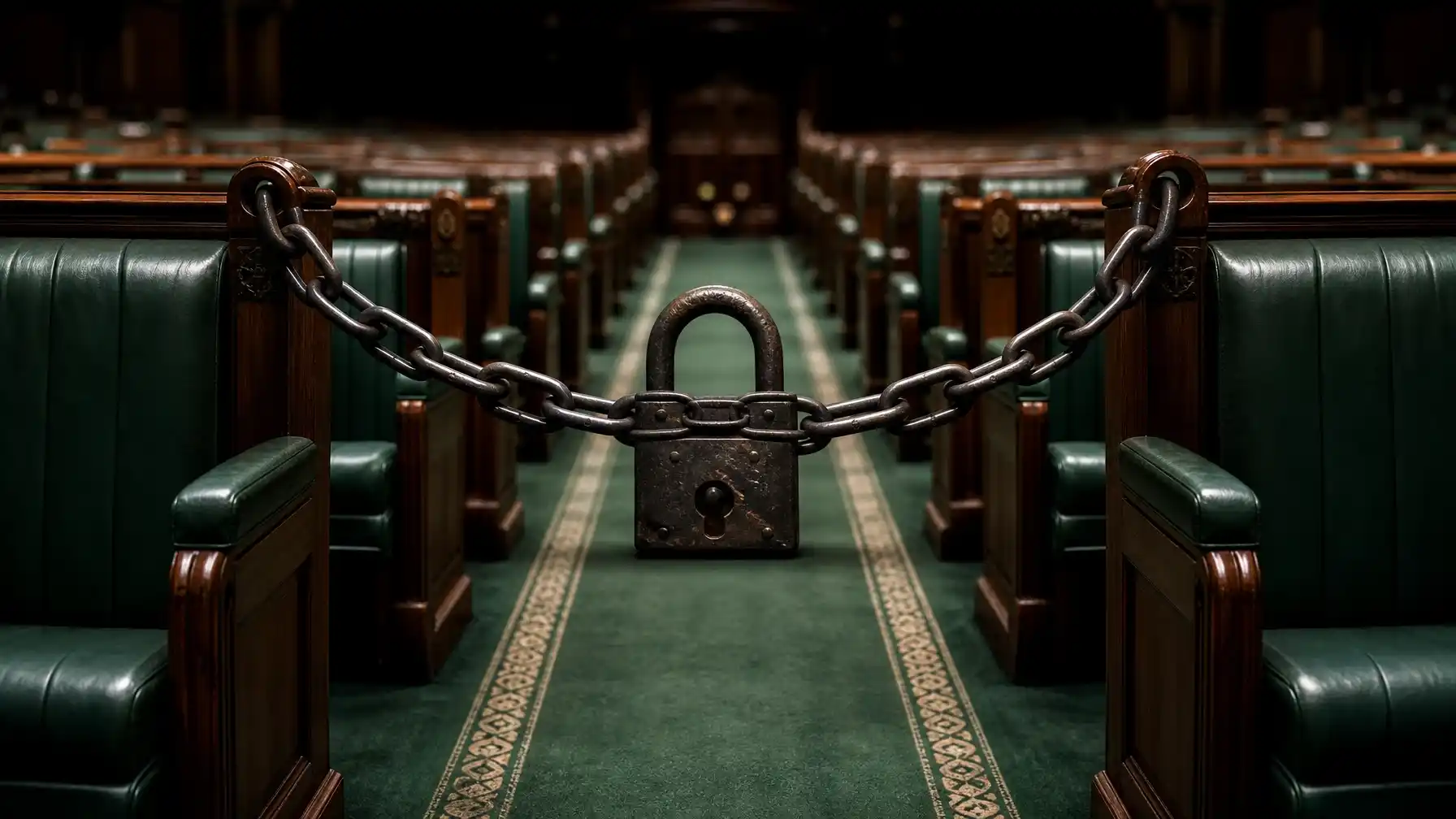
The 131st Constitutional Amendment Bill, which sought to expand Lok Sabha seats to 850, failed in Parliament, ensuring the delimitation freeze remains in force until the 2026 Census results are fully processed.
One Liners
| Fact / Entity | Detail |
|---|---|
| What | Failure of 131st Constitutional Amendment Bill in Parliament |
| When | May 2026 |
| Who | Parliament of India |
| Constitutional Articles | Article 81 (Composition of Lok Sabha); Article 82 (Readjustment after census) |
| Key Outcome | Delimitation freeze maintained; current 543-seat allocation continues |
| Proposed Target | Expansion of Lok Sabha to 850 seats |
| Significance | Defers resolution of North-South representation imbalance |
Why in News?
The 131st Constitutional Amendment Bill seeking to expand Lok Sabha seats to 850 failed in Parliament, maintaining the delimitation freeze until the 2026 Census results are fully processed. This defers the politically contentious reallocation of parliamentary representation between demographically expanding Northern states and Southern states with successful family planning outcomes.
Keyword/Terminology Hub
- Delimitation: The process of redrawing boundaries of territorial constituencies and reallocating legislative seats among states based on decennial census population data.
- Article 82: Constitutional provision mandating readjustment of Lok Sabha seats after each census, operationally frozen through amendments until the first census after 2026.
- 42nd Amendment: 1976 constitutional amendment that froze Lok Sabha seat allocation at 1971 census levels until 2001 to incentivise family planning.
- 84th Amendment: 2001 constitutional amendment extending the delimitation freeze on Lok Sabha and Assembly seat numbers from 2001 to 2026.
Background & Static Concept Link
- Definition: Delimitation is the process of fixing the limits or boundaries of territorial constituencies for elections to the Lok Sabha and State Legislative Assemblies, including the reallocation of seats among states based on population figures.
- Historical Origin: The first Delimitation Commission was constituted in 1952 under the Delimitation Commission Act. The principle of proportional representation required periodic readjustment after each decennial census to maintain equitable representation.
- Constitutional/Legal Framework:
- Article 81: Specifies composition of Lok Sabha (not more than 550 members).
- Article 82: Mandates readjustment of seats after each census.
- Article 170: Composition of State Legislative Assemblies.
- Article 327: Empowers Parliament to make laws with respect to elections.
- 42nd Amendment Act, 1976: Froze allocation of Lok Sabha seats to states at the 1971 census level until the census of 2001.
- 84th Amendment Act, 2001: Extended the freeze on the number of seats in Lok Sabha and State Assemblies until 2026.
- 87th Amendment Act, 2003: Provided for delimitation of constituencies based on the 2001 census without altering the number of seats allocated to each state.
- Institutional Framework:
- Delimitation Commission: Constitutionally empowered body under Delimitation Commission Acts to redraw constituency boundaries. The 2002 Commission was chaired by Justice Kuldip Singh.
- Election Commission of India: Conducts elections based on delimited constituencies.
- Parliament: Empowered to amend constitutional provisions regarding seat allocation and delimitation timelines.
- Chronology/Timeline:
| Year | Event |
|---|---|
| 1952 | First Delimitation Commission constituted under Delimitation Commission Act, 1952 |
| 1963 | Second Delimitation Commission |
| 1973 | Third Delimitation Commission |
| 1976 | 42nd Amendment freezes Lok Sabha seat allocation at 1971 census levels until 2001 |
| 2001 | 84th Amendment extends freeze until 2026 |
| 2002 | Fourth Delimitation Commission (Justice Kuldip Singh) redraws boundaries based on 2001 census without changing state-wise seat numbers |
| 2009 | Delimitation orders implemented for 2009 General Elections |
| May 2026 | 131st Constitutional Amendment Bill (proposing 850 seats) fails; freeze continues until 2026 Census results are processed |
- Related Static Topics / Cross References:
- Similar concepts: Reorganisation of States (1956), Federalism, Representation of the People Acts
- Linked schemes: National Population Policy, Family Planning Programme
- Associated reports: National Commission to Review the Working of the Constitution (Venkatachaliah Commission, 2002)
- Comparative examples: US Congressional reapportionment after each decennial census; UK Boundary Commissions
Key Provisions / Main Developments
| Aspect | Current Status (Post-Failure) | Implication |
|---|---|---|
| Lok Sabha Strength | Remains at 543 elected members | No expansion to proposed 850 seats |
| Basis of Allocation | 1971 Census figures (frozen) | Southern states retain relative seat share despite lower current population growth |
| Next Review Trigger | 2026 Census results processing | Delimitation can proceed only after census data is fully compiled and published |
| Constitutional Tool | Article 82 readjustment deferred | Requires fresh legislative or commission action post-2026 census |
| Inter-State Equity | Status quo maintained | Northern states with higher population growth remain under-represented per capita compared to 1971 ratios |
Mains Perspective (SPECTEL Analysis)
- Political/Legal impact: The failure preserves the existing federal balance but intensifies the democratic deficit. Northern states argue their growing populations are under-represented, while Southern states fear losing parliamentary clout and fiscal bargaining power despite having successfully implemented family planning norms. This creates a zero-sum political contest over representation that directly affects coalition dynamics and national policy formation.
- Constitutional/Cultural impact: Tests the tension between the democratic principle of equal representation and the federal compact that incentivised family planning through the original freeze. The delay means India's representative democracy continues to operate on demographic data over five decades old, raising questions about constitutional morality and the legitimacy of representative institutions.
- Economic impact: Parliamentary seat share influences the distribution of central resources and the weight of state voices in national fiscal policy. A post-2026 delimitation based on current population could significantly alter the balance of power in Finance Commission deliberations and central scheme allocations.
- Logical/Ethical conclusion: The delimitation freeze was conceived as a temporary incentive mechanism, but its persistence raises profound questions about democratic legitimacy. The failure of the 131st Amendment Bill signals that political consensus on rebalancing representation remains elusive, leaving India's federal democracy in a state of suspended demographic animation where citizens are not equally represented in proportion to their numbers.
Fact-Check & Committees
- Relevant Data/Stats: Lok Sabha currently comprises 543 elected members. The proposed expansion to 850 seats would have represented a 56% increase. As per the 1971 census, the population-representation ratio was relatively uniform across states. By the 2011 census, significant divergence had emerged: states like Uttar Pradesh, Bihar, Rajasthan, and Madhya Pradesh experienced high population growth, while Tamil Nadu, Kerala, Karnataka, and Andhra Pradesh successfully stabilised populations, creating a widening per-capita representation gap.
- Committee/Judgment: National Commission to Review the Working of the Constitution (Venkatachaliah Commission, 2002): Recommended that the freeze on Lok Sabha seats be extended beyond 2026 only if absolutely necessary, but cautioned against creating permanent demographic inequities that undermine federal harmony. 2002 Delimitation Commission (Justice Kuldip Singh): Redrew constituency boundaries based on the 2001 census without altering the number of seats allocated to each state, as mandated by the 87th Constitutional Amendment.
- Quote: "The House of the People shall consist of not more than five hundred and thirty members chosen by direct election from territorial constituencies in the States." — Article 81(1)(a), Constitution of India.
Exam Lens
- UPSC/State PCS Mains angle: "The constitutional freeze on Lok Sabha seat allocation, originally intended as an incentive for family planning, has created a significant democratic deficit in India's federal structure. Critically examine the implications of deferring delimitation beyond 2026 on centre-state relations, representation equity, and the politics of cooperative federalism."
- Essay angle: "One person, one vote, one value? The delimitation dilemma and the future of Indian federalism."