
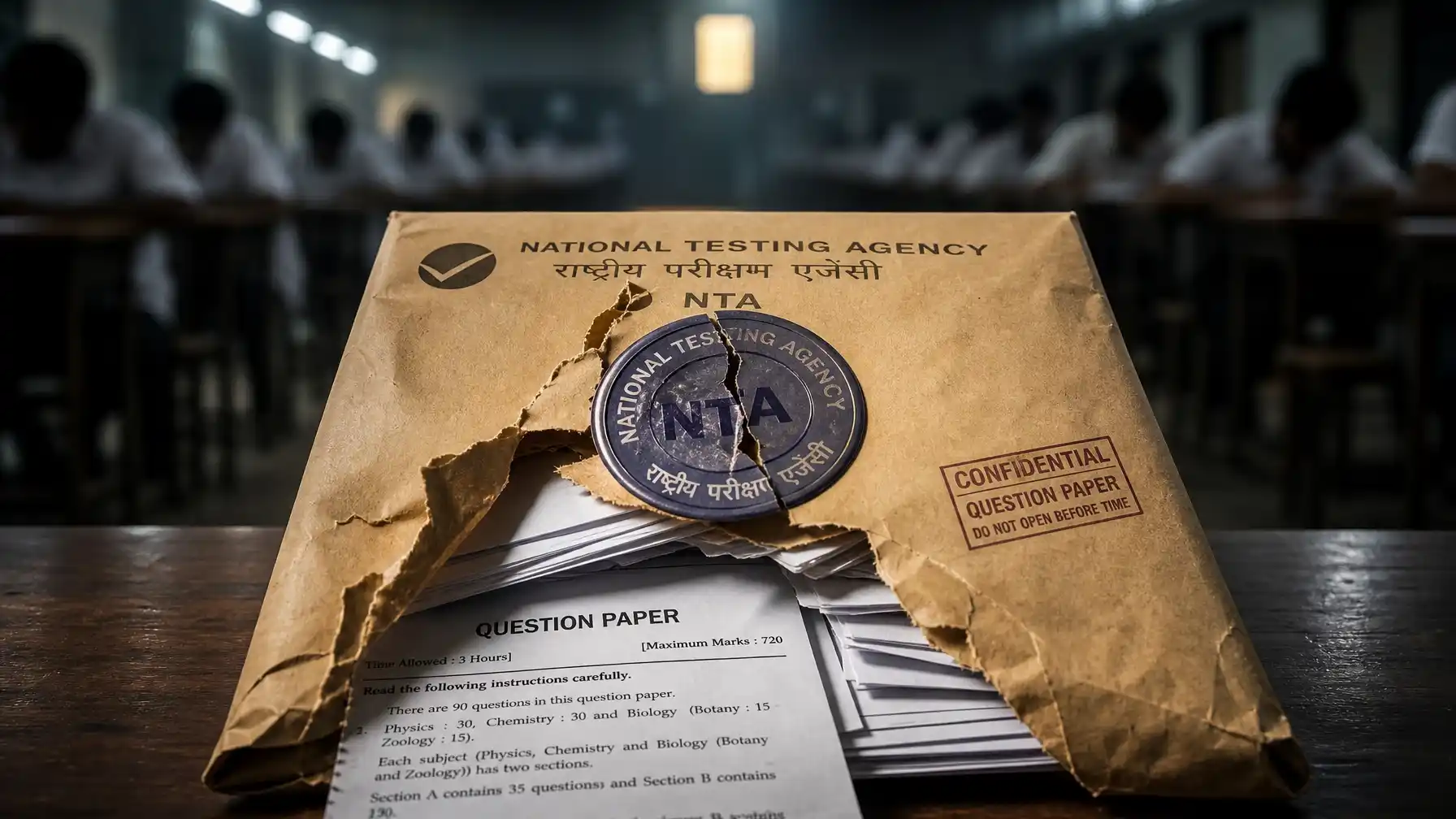
The NTA officially admitted the 2026 NEET-UG examination was compromised due to paper leaks, announcing a re-test for approximately 22.79 lakh students and sparking a national debate on restructuring or replacing the agency.
One Liners
| Fact / Entity | Detail |
|---|---|
| What | NTA officially states NEET-UG 2026 compromised due to paper leaks |
| When | May 2026 |
| Who | National Testing Agency (NTA); ~22.79 lakh affected students |
| Ministry/Organization | Ministry of Education (NTA operates under Department of Higher Education) |
| Key Outcome | Re-test announced for all 22.79 lakh registered candidates |
| Policy Debate | "Zero Error" policy questioned; demands for high-powered committee to restructure/replace NTA |
| Exam Type | National Eligibility-cum-Entrance Test (Undergraduate) for MBBS/BDS/AYUSH |
Why in News?
The NTA's admission that NEET-UG 2026 was compromised due to paper leaks has forced a re-test for 22.79 lakh students, marking the most severe credibility crisis for India's medical entrance system since the agency's inception. The fallout has triggered demands for a high-powered committee to restructure or replace the NTA, spotlighting systemic vulnerabilities in centralized computer-based testing.
Keyword/Terminology Hub
- National Testing Agency (NTA): Autonomous organization under the Ministry of Education established in 2017 to conduct standardized entrance examinations for higher educational institutions.
- Zero Error Policy: NTA's stated quality assurance framework ensuring error-free question papers and secure examination delivery, now critically undermined.
- Computer-Based Testing (CBT): Digital examination delivery mode used by NTA, raising concerns about cybersecurity, server crashes, and remote leak vulnerabilities.
- Re-conduct/Re-test: Administrative decision to hold the examination again for all candidates when integrity is compromised, carrying massive logistical and psychological costs.
Background & Static Concept Link
- Definition: NEET-UG (National Eligibility-cum-Entrance Test — Undergraduate) is the single national-level entrance examination for admission to MBBS, BDS, AYUSH, and other undergraduate medical courses in India, conducted by the National Testing Agency.
- Historical Origin: Prior to 2019, medical entrance exams were conducted by CBSE, AIIMS, and individual state governments. The NTA was established to standardize and professionalize entrance examinations. NEET itself was mandated by the Supreme Court in 2016 to replace multiple entrance tests and reduce student burden.
- Constitutional/Legal Framework:
- Article 21: Right to life and personal liberty, judicially interpreted to include the right to fair and transparent examinations as part of career and livelihood rights.
- Article 14: Right to equality, requiring non-discriminatory and fair examination processes for all candidates.
- National Medical Commission Act, 2019: Replaced the Medical Council of India and mandated NEET as the common entrance test for medical education.
- NTA Constitution: Registered under the Indian Societies Registration Act, 1860, functioning under the Department of Higher Education, Ministry of Education.
- Institutional Framework:
- National Testing Agency (NTA): Conducts NEET-UG, NEET-PG, JEE Main, CUET, and other national entrance examinations.
- Ministry of Education: Administrative ministry overseeing NTA policy and funding.
- National Medical Commission (NMC): Regulatory body for medical education that mandates NEET qualification for undergraduate admissions.
- Central Bureau of Investigation (CBI): Typically investigates organized paper leak cases involving national examinations.
- Chronology/Timeline:
| Year | Event |
|---|---|
| 2017 | NTA established under Ministry of Education to conduct entrance examinations |
| 2019 | First NEET-UG conducted by NTA; National Medical Commission Act replaces MCI |
| 2020 | NEET-UG postponed due to COVID-19 pandemic |
| 2024 | Previous NEET-UG paper leak controversy and allegations of irregularities |
| 2025 | NTA introduces enhanced security protocols and "Zero Error" policy |
| May 2026 | NTA admits NEET-UG 2026 compromised; re-test announced for 22.79 lakh students |
- Related Static Topics / Cross References:
- Similar concepts: UPSC Civil Services examination integrity, Staff Selection Commission (SSC) leaks, UGC-NET irregularities
- Linked schemes: National Education Policy 2020 (standardized testing), Ayushman Bharat (medical workforce pipeline)
- Associated reports: Parliamentary Standing Committee on Education reports on examination reforms
- Comparative examples: SAT/ACT integrity protocols in the United States; China's Gaokao security measures
Key Provisions / Main Developments
| Development | Operational Detail |
|---|---|
| Paper Leak Confirmation | NTA officially acknowledges compromise of NEET-UG 2026 question paper integrity |
| Re-test Announcement | Full re-conduct ordered for approximately 22.79 lakh registered candidates |
| Zero Error Policy Failure | NTA's internal quality assurance framework proven inadequate against organized leak networks |
| CBT Vulnerabilities | Digital examination infrastructure suspected of breach, raising questions about server security and encryption protocols |
| Restructuring Demand | Widespread calls for a high-powered committee to replace or fundamentally restructure NTA |
Mains Perspective (SPECTEL Analysis)
- Social impact: The leak devastates the meritocratic aspirations of 22.79 lakh students, many from modest backgrounds who depend on a fair examination for social mobility. The psychological trauma, financial burden of re-preparation, and erosion of trust disproportionately affect first-generation learners and rural candidates who lack resources for repeated coaching.
- Political/Legal impact: The crisis exposes regulatory gaps in the oversight of autonomous examination bodies. It raises questions about the Ministry of Education's supervisory accountability and may invite judicial intervention under Articles 14 and 21 to enforce structural reforms in examination governance.
- Economic impact: The re-test imposes massive direct costs (logistics, security, infrastructure) and indirect costs (coaching centre extensions, parental leave, travel expenses). It also threatens India's medical education pipeline, potentially delaying the induction of future doctors into the healthcare workforce.
- Technological impact: Highlights critical cybersecurity gaps in India's centralized digital examination infrastructure. The failure of CBT security protocols suggests the need for blockchain-based question paper encryption, biometric verification, and decentralized server architecture.
- Logical/Ethical conclusion: An examination system that cannot guarantee integrity is fundamentally illegitimate. The NEET-UG 2026 leak is not merely an operational failure but a governance crisis that demands institutional redesign rather than cosmetic fixes. The demand for a high-powered committee reflects recognition that the NTA's current autonomous structure lacks adequate checks and balances.
Fact-Check & Committees
- Relevant Data/Stats: NEET-UG 2026 registered approximately 22.79 lakh candidates, making it one of the world's largest single-day entrance examinations. India produces roughly 1 lakh MBBS graduates annually. The NTA, established in 2017, currently conducts over 20 examinations including JEE Main, CUET, and NEET-PG.
- Committee/Judgment: Parliamentary Standing Committee on Education (2024): Previously flagged NTA's infrastructural and security inadequacies. Supreme Court in various NEET petitions (2024): Intervened in previous NEET irregularities, emphasizing the right to fair examination under Article 14. K. Radhakrishnan Committee (2023): Recommended comprehensive reforms in examination conduct and digital security architecture.
- Quote: "The future of India lies in its classrooms, and the integrity of its examinations is the foundation of its meritocracy." — Adapted from Dr. A.P.J. Abdul Kalam's educational philosophy.
Exam Lens
- UPSC/State PCS Mains angle: "The recurring paper leaks in India's centralized entrance examinations reflect a systemic governance failure rather than isolated security lapses. Examine the structural vulnerabilities of the National Testing Agency and suggest reforms to ensure examination integrity in the digital age."
- Essay angle: "In an age of digital examinations, the leak of a question paper is not just a crime — it is an assault on the social contract of meritocracy."